
The 4WD Beach Where the Asphalt Ends — and Your Dignity Is Optional
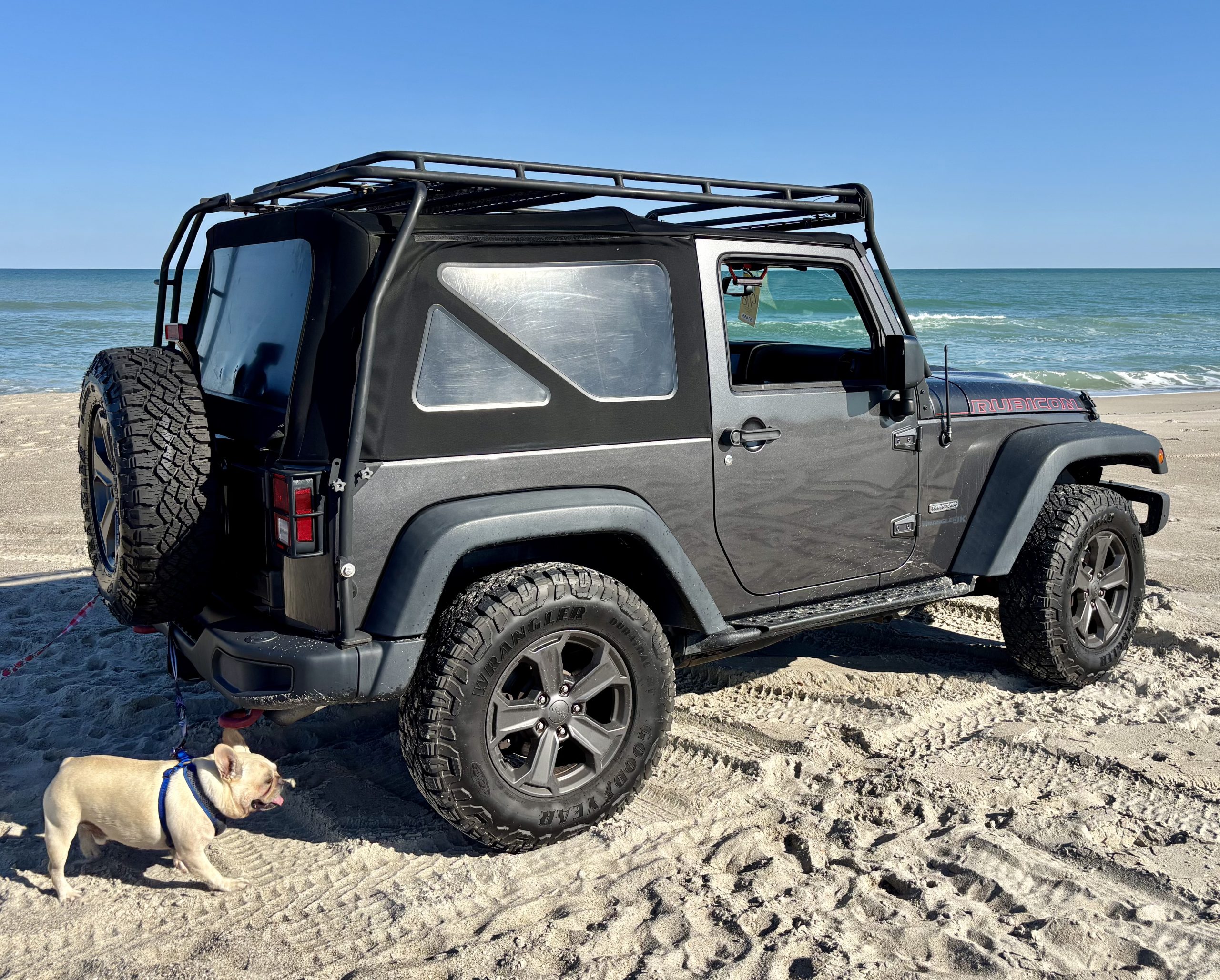
One minute you’re cruising the familiar, sun‑bleached grid of Carolina Beach and Kure Beach, North Carolina, and the next, you’re preparing to drive though, basically, a giant sandbox. Our new Jeep Wrangler (purchased in a fit of “we live here now, we’re coastal people!” optimism) idled nervously as we crouched beside the front tire, letting out air while a local in a rusted Ram 2500 watched with the kind of smirk that only a true local can master.
“Ya’ll know what you’re doing, right?” he asked.
We nodded. Confidently. Incorrectly.
Welcome to Fort Fisher State Recreation Area’s 4WD Beach — the place where locals thrive, tourists panic, and the sand eats rental cars for breakfast.
Why Fort Fisher’s 4WD Beach Is the Wildest Legal Thing You Can Do With a Vehicle in North Carolina
We were total newbies to 4WD beach driving. The first couple of times were, frankly, terrifying. Forget the “smooth glide” promised in commercials. Sand driving is a brutal negotiation between momentum, physics, and sheer nerve. That first inlet of thick, deep sand near the entrance felt like trying to drive through wet cement. The steering wheel jerked violently. The engine roared, but the Jeep didn’t so much move forward as it did sink. I made the classic rookie mistake: I panicked and slammed on the gas. My tires did exactly what they were designed to do on pavement — grabbed traction —but in the sand, they simply became highly efficient shovels, burying us axle-deep in seconds.
Once you are on the Fort Fisher 4WD beach, the challenge shifts from depth to geometry.
Fort Fisher isn’t a highway; it’s a dynamic environment that changes by the hour. We quickly learned to live by the tide chart. The “easiest” time to drive is low tide, when a wide band of hard-packed wet sand is exposed near the waterline. This is the “fast lane,” allowing for smooth, easy travel at the posted 15 mph speed limit. However, you must be wary of high tide. As the water rises, it forces all vehicle traffic higher up the beach strand into the loose, soft “sugar sand.” These parts become incredibly narrow, sometimes offering just enough room for a single vehicle between the impassable dunes and where the waves are breaking.
One of our first tricky experiences involved being caught in a narrow section during an incoming tide. The ocean was shockingly close. When you’re driving and the waves are actually breaking next to your vehicle, spraying your doors with saltwater, the “primordial” feeling of the wild coast becomes very, very real. Maintain your momentum in these sections. If you must pass another vehicle, use your turn signal to indicate which rut you are claiming and move deliberately.
We eventually learned, but the price of that education was paid in humility, a significant amount of digging, and the distinct knowledge that we were, for a short while, the entertainment.
4WD Beach Driving – Don’t Be The Idiot
Do something dumb and you WILL end up on the Idiot Spotter, the Facebook group where locals visciously roast anyone who attempts Fort Fisher in a sedan, crossover, or anything with the words “luxury” in the name. It’s a repository of local schadenfreude, populated by daily photos of tourists and the occasional overconfident transplant who thought their front-wheel-drive Toyota Camry could handle a barrier island. They are pictured bottomed-out on the access ramp, high-centered on a dune, or worst of all, bogged down within striking distance of a rising tide. They almost always have to pay hundreds of dollars to be winched out by specialized towing services because park rangers generally cannot assist with non-emergency recovery.
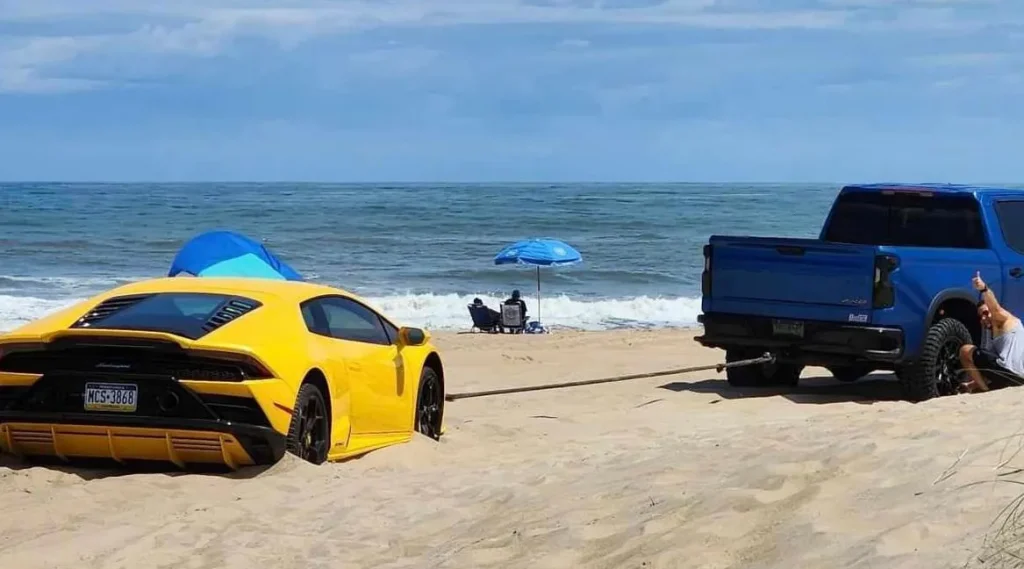
Don’t be that guy.
The Rules of the Sand: How Not to Become Internet Famous for the Wrong Reasons
To handle Fort Fisher 4WD beach driving, you need a true 4-wheel-drive vehicle with high ground clearance. Jeeps, Broncos, and full-sized pickups thrive here. All-wheel-drive (AWD) systems frequently fail because they lack the low-range gearing and locking differentials needed to prevent wheels from spinning uselessly in the deepest pockets.
The single most critical step, however, is “airing down.” Before your tires even touch the sand, pull into the designated parking lot and drop your tire pressure to roughly 18–20 psi. By increasing the tire’s “footprint,” you allow your vehicle to “float” on top of the sand rather than digging in. Forgetting this is the number one reason people get stuck before they even reach the water.
1. Air Down or Go Home
Before your tires touch sand, pull into the lot and drop to 18–20 psi. This is non-negotiable. This is religion. Aired-down tires spread out, giving you flotation instead of digging you a grave. Locals tip: Bring a portable air compressor so you can reinflate before heading home. The Sheetz is NOT where you want to be hogging the air pump while locals judge you.
2. True 4WD Only
AWD is the participation trophy of off-roading. Fort Fisher requires the real deal: Low range, Locking diffs, Ground clearance, and a vehicle that doesn’t cry when it sees sand
Think: Wrangler, Bronco, Tacoma, 4Runner, F‑150, Silverado.
Not: Subaru Outback, Honda CR‑V, Tesla anything.
3. Know the Tides or Prepare for Saltwater Baptism
Low tide = smooth, hard-packed sand = the “express lane.” High tide = soft, deep sand + cliffs of dunes = the “good luck, buddy” lane. We once misjudged the tide and ended up driving with waves slapping the Jeep doors like they were trying to get in. Nothing humbles you faster than realizing the Atlantic Ocean is closer to your vehicle than your cupholders.
If You Get Stuck, Here’s the Playbook
Despite your best efforts, it might happen. You’ll feel the engine bog down. The best advice is counterintuitive: STOP. Do not spin your tires. You will only make the hole deeper and high-center your chassis.
Acknowledge You’re Stuck
The sooner you accept it, the less digging you have to do. Spinning your tires only digs you deeper and guarantees you’ll be starring in someone’s Instagram story.
Reverse Out Like You Meant to Do That
Back out along your own tracks. If that fails…
Use Your Shovel (You brought one, right?)
Clear the sand from around all four tires and from under the frame or axles that are high-centered. Dig like you’re escaping Shawshank.
Drop Pressure Again
Go to 15 psi. If you’re desperate, 12 psi — but avoid sharp turns or you’ll pop a bead.
Traction Aids Are Your New Best Friends
MAXTRAX are ideal, but in a pinch, your vehicle’s rubber floor mats, placed firmly under the drive tires, can provide the friction needed to pop you out of the hole.
Your dignity is optional.
4WD Beach Driving – Going Topless
When you finally master the 4WD beach driving technique, the reward is total freedom. The true local tradition isn’t just driving; it’s the beach camp.
We eventually got our setup down to a science. We’d drive parallel to the ocean, find our perfect stretch, and claim it. We’d stake 12-foot surf rods in the sand and wait for drum, use customized sand anchors to string a hammock between the Jeep’s roll bars, and light up a full-sized charcoal grill for a lunchtime feast of burgers or fresh-caught fish. The ability to spend an entire day with your cooler, chairs, and kids right there, miles away from the crowds of the public accesses, is an unmatchable luxury.
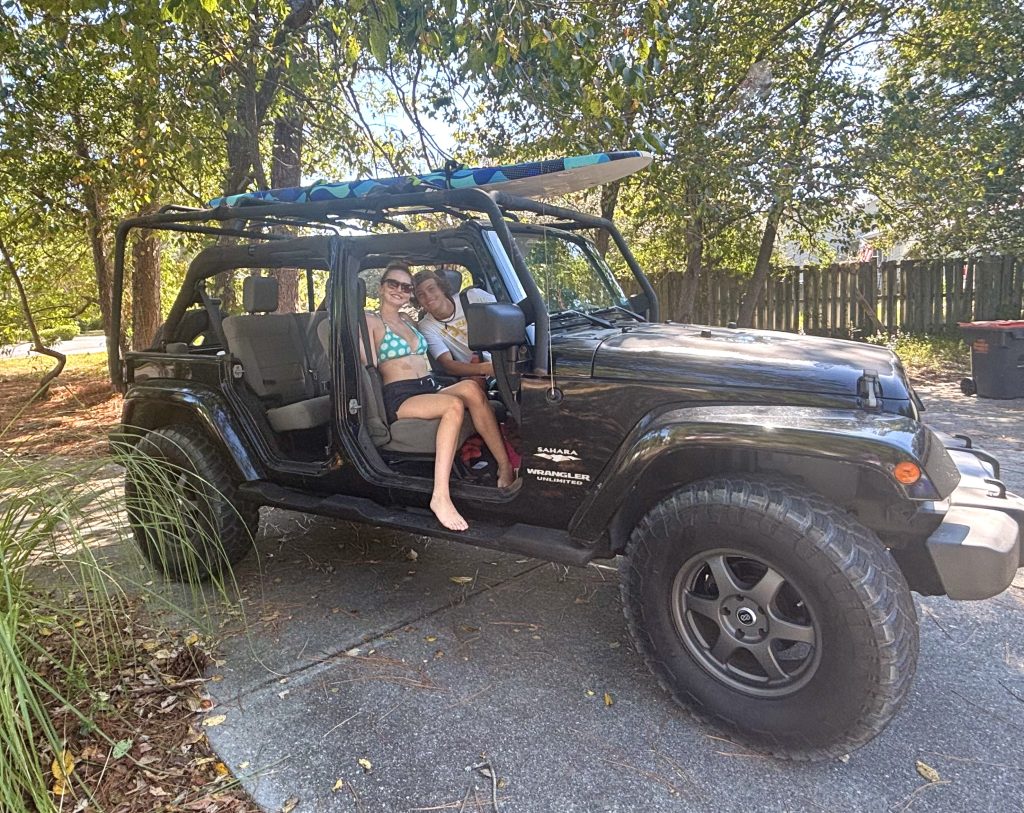
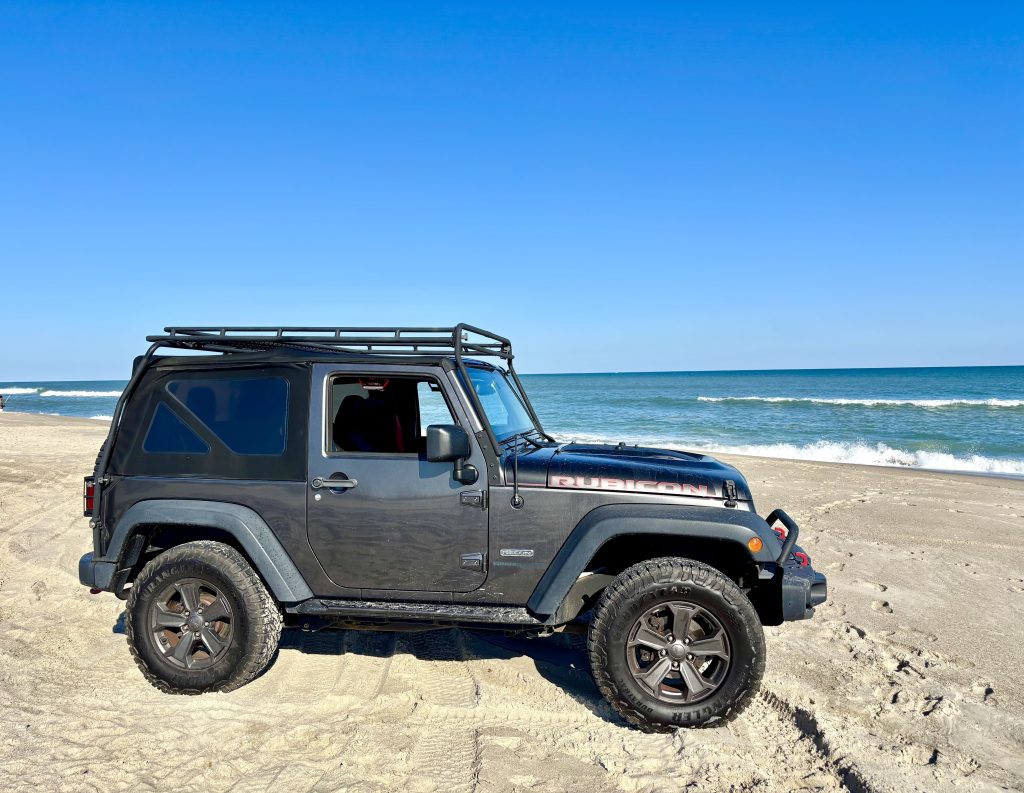
TOPLESS BEACH DRIVING IN YOUR JEEP
You can spread out for miles with no crowds, no boardwalk noise, no fighting for parking. Just you, the ocean, and the occasional pelican watching your casting technique.
Military Families: You Hit the Jackpot
For military families, this Fort Fisher 4WD beach driving luxury is even more accessible.
Under NC State Law 2024‑45, veterans with a service-connected disability qualify for a FREE annual Fort Fisher 4WD beach access pass (normally $200). Just bring your VA Summary of Benefits Letter to the Fort Fisher office. This is one of the best military perks in the state — unlimited access to one of the last wild beaches on the East Coast.
Don’t Be the Reason They Ban Beach Driving
Fort Fisher is a fragile ecosystem. Treat it like a privilege, not a playground. That privilege comes with a shared responsibility. The dunes and maritime forests are not just background scenery; they are critical barriers against storm surges and vital habitats for endangered species.
- Environmental Impact: The single most important rule is NEVER DRIVE ON THE DUNES. One pass can destroy stabilizing vegetation that took decades to grow, leading to massive erosion.
- Wildlife Protection: Be extremely vigilant during nesting season (roughly May through August). Specialized shorebirds like the piping plover and green sea turtles use this beach. Rangers will often mark off nesting areas with ropes and signs. Give these areas a wide berth.
- Leave No Trace: Everything you bring in must come out. This includes charcoal ash, which can be highly toxic to the marine environment if left on the sand. Use a portable ash can or a specialized container to pack out your grill remains.
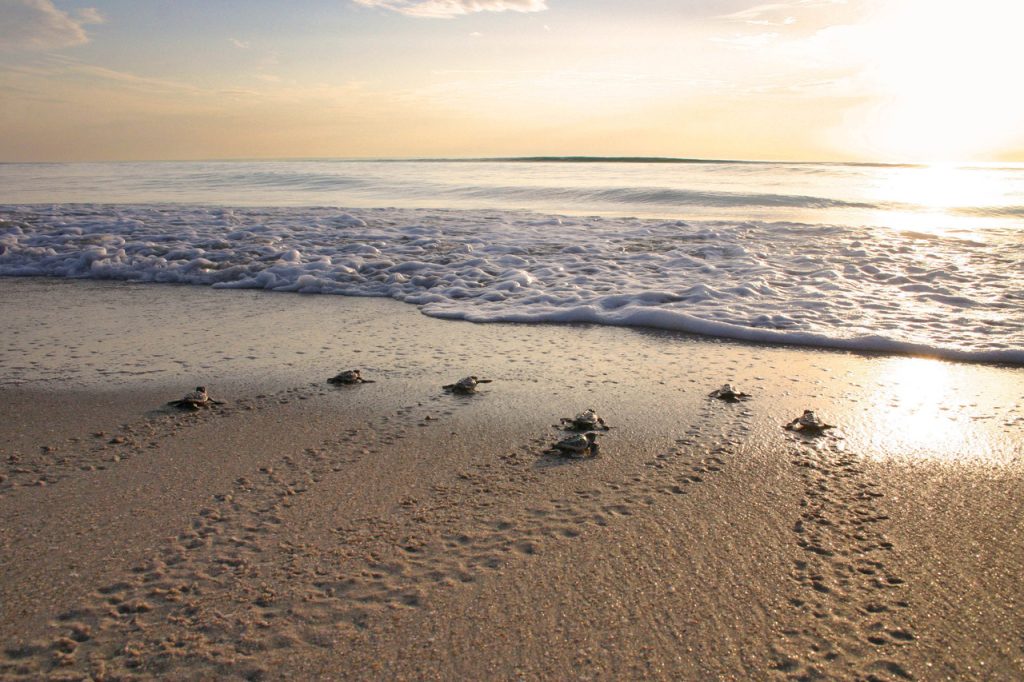
The North End — Fort Fisher’s Wild Cousin With Fewer Rules but More Chaos
Most people think Fort Fisher’s 4WD beach is the only place you can legally drive on the sand around here, but that’s only because they haven’t wandered far enough north to discover the Freeman Park North End on Carolina Beach. If Fort Fisher is the responsible older sibling who pays their bills on time, the North End is the cousin who shows up to Thanksgiving with a sunburn, a cooler full of White Claws, and a story that starts with “So the ranger said we couldn’t, but…”
To get there, you drive straight through Carolina Beach, past the boardwalk, past the pastel rentals, past the point where the pavement starts to look nervous — and then you hit the entrance gate to Freeman Park. You’ll need a separate pass (daily or annual), and yes, they do check. Once you’re through, the vibe shifts instantly. The sand is looser, the crowds are younger, the music is louder, and the beach tents look like they were engineered by people who take tailgating as seriously as religion.
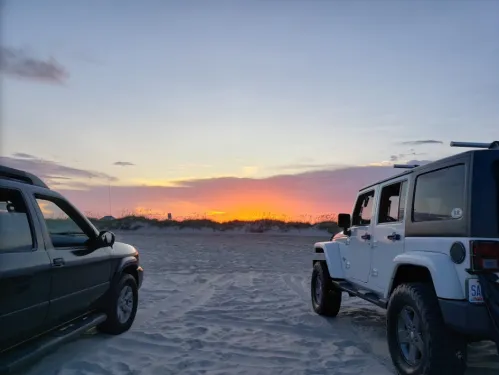
The North End is where you go if you want the full “beach party meets off‑road adventure” 4WD Beach Driving experience.
It’s rowdier, more social, and more unpredictable. You’ll see lifted trucks with flags, Jeeps with names, and at least one group who brought a full living‑room setup complete with a rug. It’s also where you learn very quickly that tides don’t care about your Bluetooth speaker or your cooler full of seltzers. Every year, someone misjudges the waterline and ends up with a saltwater‑soaked interior and a very expensive lesson in humility.
But when the weather is perfect and the tide is low, the North End feels like a secret coastal kingdom — a place where you can park your Jeep at the edge of the world, crack open a drink, and watch the sun melt into the horizon while pelicans skim the waves like they’re on a mission. It’s chaotic, it’s beautiful, and it’s absolutely worth experiencing at least once, preferably with someone who knows how to read a tide chart.
Other Places in the U.S. Where You Can Drive on the Beach
Fort Fisher and Freeman Park aren’t the only military or civilian places in America where you can legally put rubber to sand — though it’s one of the best. If you ever want to take your newfound sand‑driving skills on tour, here are a few of the country’s other iconic drive‑on beaches, each with its own personality and set of rules.
Ocracoke Island, North Carolina
Part of Cape Hatteras National Seashore, Ocracoke offers miles of wild, undeveloped shoreline where you can drive right up to the surf. It feels like the Outer Banks before the Outer Banks got famous.
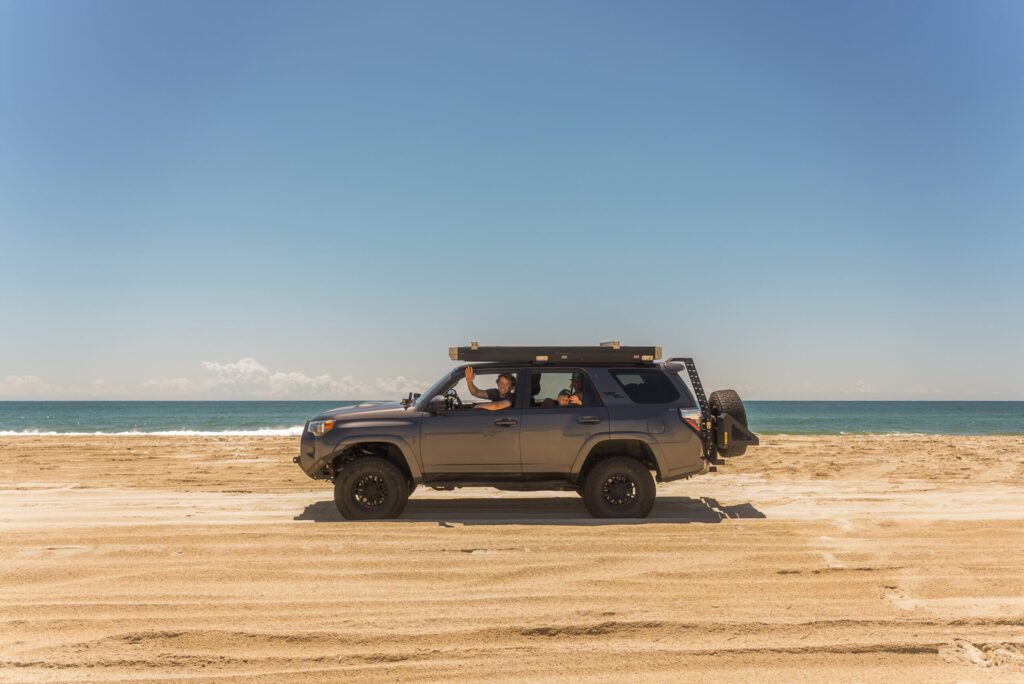
Daytona Beach, Florida
The OG of drive‑on beaches. It’s flatter, wider, and more commercial, but there’s something iconic about cruising along the same sand where early NASCAR races were held.
Oregon Dunes National Recreation Area, Oregon
This is where you go if you want to feel like you’re driving on Mars. Towering dunes, open sand bowls, and off‑road culture that borders on extreme sports.
Pismo Beach, California (Oceano Dunes)
Oceano Dunes State Vehicular Recreation Area is one of the last remaining drive‑on beaches on the West Coast. It’s a bucket‑list destination for off‑roaders, though access rules change frequently due to environmental protections.
Assateague Island, Maryland/Virginia
Wild horses, remote beaches, and a permit system that keeps crowds low. It’s rugged, quiet, and perfect for people who want solitude with their sand driving.
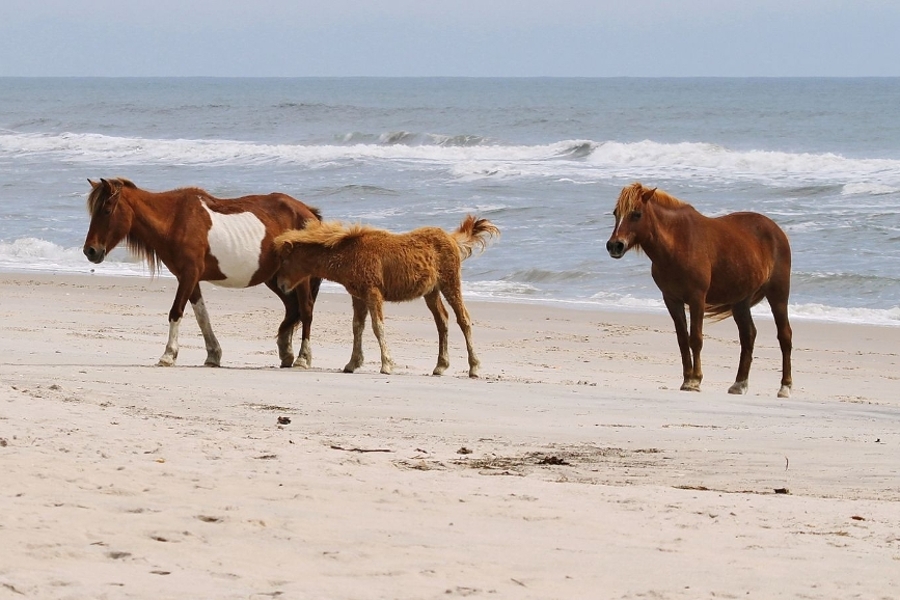
Each of these places has its own quirks — different sand textures, different rules, different levels of “you might get stuck and strangers will judge you.” But once you’ve conquered Fort Fisher, you’re basically ready for all of them.
Why We Keep Coming Back
These 4WD beaches are some of the last places where you can still feel the raw, unpolished, slightly dangerous thrill of the coast. It’s not safe and sanitized. It’s not the “family-friendly beach day with bar service” you see in brochures.
It’s better.
It’s the place that taught us how to dig out a Jeep without filing for divorce. It’s where we learned to read the tides, trust the ruts, and appreciate the wildness that still exists between Wilmington and the sea.
And every time we see a sedan creeping toward the ramp, we whisper a little prayer for them — and we make sure our shovel is ready, just in case.